There was a season in our house when dinosaurs seemed to be everywhere.
Tiny plastic dinosaurs marched across the kitchen table. They hid beneath couch cushions, traveled in jacket pockets, and somehow found their way into the washing machine with alarming regularity. Every stick became a dinosaur bone, every pile of dirt an excavation site.
At first, it felt like a phase.
But somewhere along the way, something changed.
We stopped simply reading about dinosaurs and started noticing them.
Not actual dinosaurs, of course… but the evidence they left behind.
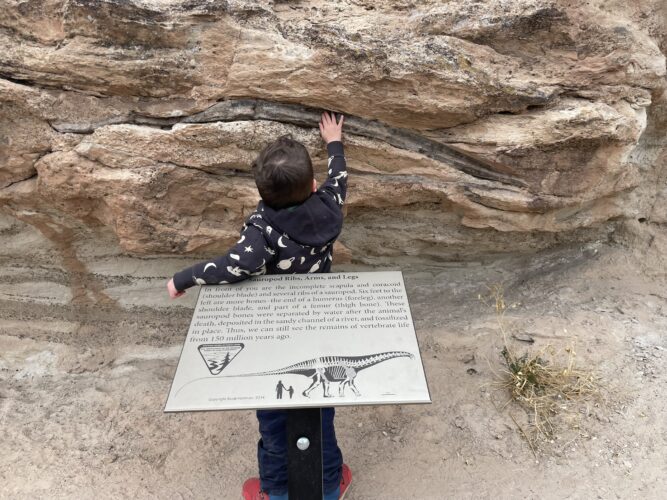
A hike through Utah suddenly wasn’t just a hike. It became a search for footprints pressed into sandstone more than 100 million years ago. A piece of petrified wood discovered beside our snack spot on the trail wasn’t just an interesting rock… it was a tree that had lived during an unimaginably different world. The towering butte that rises above our Colorado valley, a volcanic laccolith formed during the age of the dinosaurs, became more than a familiar landmark. It became a reminder that the landscapes we love have stories far older than we ever imagined.
Once you begin looking, you realize it’s everywhere.
The cliffs.
The rivers.
The layers of rock.
The fossils tucked into museum drawers.
The ancient seabeds that became mountaintops.
The birds in your backyard… living descendants of dinosaurs.
What began as one little boy’s fascination slowly changed the way our entire family experienced the outdoors.
It turns out dinosaurs aren’t just something children memorize.
They’re an invitation.
An invitation to wonder.
To imagine.
To slow down.
Why Kids Love Dinosaurs
Every Landscape Has a Story
Stand with a little kiddo on almost any trail, and sooner or later they’ll ask a question that stops you in your tracks.
“Do you think dinosaurs lived here?”
It’s an innocent question… but it’s also a remarkable one.
Without realizing it, they’re imagining a place that existed millions of years before they were born. They’re looking beyond the trees, the mountains, or the desert in front of them and wondering what came before.
That’s the beginning of exploration.
At Trail West, we believe every landscape tells a story. Some stories are only a few decades old… a historic cabin, an abandoned railroad grade, a weathered trail built by early explorers or miners. Others stretch back thousands of years through Indigenous cultures and ancient civilizations.
And some stories are almost impossible to imagine.
Long before Colorado’s alpine meadows bloomed with wildflowers… before Utah’s sandstone canyons were carved by rivers… before Wyoming’s wide valleys echoed with elk bugles… giant creatures wandered through lush floodplains, ancient forests, and shallow inland seas.
The places we love to explore today were once completely different worlds.
That’s what makes dinosaurs so captivating.
Yes, they’re enormous. A Stegosaurus was the size of a school bus. An Apatosaurus weighed more than a dozen elephants. A Tyrannosaurus rex towered over nearly everything in its path.
But size alone doesn’t explain why children become so fascinated.
Dinosaurs are mysterious.
They invite imagination.
They disappeared long before humans arrived, leaving behind only scattered clues locked inside rocks. Every fossil, every footprint, and every exposed cliff feels like part of a puzzle waiting to be solved.
To a child, that’s irresistible.
A strange rock might actually be a fossil.
A dry creek bed could become an ancient river.
A hike isn’t just a walk anymore—it’s a chance to discover evidence from another world.
Children don’t see an empty landscape.
They see possibility.
Developmental researchers have found that many young children develop what psychologists call “intense interests”—subjects that capture their attention with extraordinary enthusiasm and focus. Rather than being a distraction, these deep interests often become powerful engines for learning. They can expand vocabulary, strengthen memory, encourage sustained attention, and inspire children to ask increasingly thoughtful questions about how the world works.
Anyone who has shared a trail with a dinosaur-loving child has probably seen this happen.
A preschooler who can’t remember where they left their jacket somehow pronounces Parasaurolophus (PAIR-uh-sawr-OL-uh-fuss) with complete confidence. They compare species, debate herbivores versus carnivores, notice tiny differences in footprints, and eagerly explain why the Jurassic came before the Cretaceous.
More importantly, they begin noticing things they might otherwise walk right past.
They slow down. They look closely. They ask why.
That may be the greatest gift dinosaurs offer.
Because curiosity changes how we experience the outdoors.
They turn ordinary trails into journeys through time.
Trail West Thought
“A child who loves dinosaurs already thinks like an explorer.”
The goal isn’t to raise an expert on prehistoric life.
It’s to raise someone who never stops asking what stories the world beneath their feet might still have to tell.
What Paleontologists Really Do
Becoming a Detective of Deep Time
Ask a group of five-year-olds what a paleontologist does, and you’ll probably hear the same answer.
“They dig up dinosaur bones!”
They’re not wrong… but they’re only seeing the final chapter of a much bigger story.
In reality, paleontologists spend surprisingly little of their time uncovering giant skeletons (sadly!). Most of their work happens long before a shovel ever touches the ground and long after a fossil leaves the field.
At its heart, paleontology isn’t about finding dinosaurs… It’s about asking questions.
Every fossil begins as a mystery.
- Who left it behind?
- How did it get here?
- What did this place look like millions of years ago?
- What can this single clue tell us about an entire world that no longer exists?
The answers rarely come from one spectacular discovery. Instead, they’re built slowly from hundreds—even thousands—of careful observations gathered over years of work.
That’s one of the reasons paleontology is such a wonderful model for curious kids.
It teaches that discovery isn’t about luck.
It’s about learning to notice what others walk past.
The Scientific Process Begins with Curiosity
Long before paleontologists publish research papers or uncover museum-worthy fossils, they practice a simple set of habits that every child can learn.
Observe Carefully
A trained paleontologist notices details that most people overlook.
A slight change in rock color.
A pattern in the hillside.
A fragment of bone weathering out of the ground.
An unusual footprint preserved in sandstone.
Children already have this instinct.
They stop to inspect pebbles, pick up feathers, crouch beside insects, and ask endless questions about things adults often hurry past.
Those moments aren’t distractions from the adventure.
They are the adventure.
Ask Questions
Science begins with curiosity.
Instead of assuming they already know the answer, paleontologists keep asking:
- Why is this fossil here?
- How old is this rock layer?
- Was this once a river?
- What animals lived together?
Kids are remarkably good at this part.
In fact, many adults spend years relearning the habit of asking thoughtful questions after childhood naturally taught it to them.
Record What You See
No one remembers every detail. That’s why paleontologists fill notebooks with sketches, measurements, photographs, maps, and observations.
A simple drawing made in the field can become just as valuable as the fossil itself.
Keeping a field journal slows us down. It encourages us to really see a place instead of simply passing through it.
Compare the Evidence
One fossil rarely tells the whole story.
Scientists compare discoveries from different locations, different rock layers, and even different continents.
Piece by piece, a larger picture begins to emerge.
Children do this naturally, too.
They compare leaves… Animal tracks… Cloud shapes… Rocks.
They look for patterns because that’s how humans make sense of the world.
Test Ideas
Good scientists aren’t afraid to change their minds.
Sometimes new evidence confirms an idea. Sometimes it completely changes the story.
That’s one of the most exciting parts of science.
Every new discovery has the potential to rewrite what we thought we knew.
Share Discoveries
Science isn’t complete until discoveries are shared.
Paleontologists publish research, teach students, create museum exhibits, and help others understand Earth’s history.
Knowledge grows when curiosity is shared.
The same is true for families.
One child pointing out an unusual rock can spark a conversation that changes how everyone experiences the rest of the hike.
A Day in the Life of a Paleontologist
Hollywood often shows paleontologists brushing sand off a giant dinosaur skull beneath a blazing desert sun.
While fieldwork is certainly part of the job, it’s only one piece of a much larger picture.
Many days are spent hiking across remote landscapes, carefully mapping rock formations, searching for clues hidden in cliffs and canyons, or documenting fossil sites before anything is excavated.
Back in the laboratory, fossils are painstakingly cleaned, stabilized, measured, photographed, and compared with discoveries from around the world. Some specimens spend months—or even years—in preparation before they’re ready to be studied.
Museums become another workplace. Collections containing millions of fossils allow scientists to revisit discoveries made decades ago using new technologies and new questions.
Many paleontologists also teach at universities, mentor students, illustrate scientific papers, collaborate with artists to reconstruct prehistoric environments, or work with land managers to protect important fossil sites for future generations.
In other words, paleontology is part adventure, part detective work, part history, part geology, part biology, and part storytelling.
It’s a profession built on curiosity.
And that’s something every family can practice… whether you’re standing in Dinosaur National Monument or exploring a neighborhood trail after dinner.
After all, every explorer starts the same way.
By looking a little closer.
Trail West Thought
The greatest discoveries rarely begin with finding something extraordinary.
They begin with noticing something ordinary that everyone else walked past.
Field Notes: Paleontologist or Archaeologist?
These two careers are often confused, but they study very different parts of Earth’s story.
A Paleontologist studies ancient life that existed long before humans. Their work includes dinosaurs, prehistoric mammals, fossil plants, ancient oceans, and the rocks that preserve them. They’re exploring life that may be millions of years old.
An Archaeologist studies human history through the objects people left behind… everything from stone tools and pottery to ancient buildings and campsites. Their discoveries help us understand how people lived, traveled, farmed, created art, and built communities.
Both professions are detectives of the past.
The difference is where they begin.
Paleontologists uncover the story of life before people.
Archaeologists uncover the story of people themselves.
Together, they help us understand the remarkable journey that brought us to the landscapes we explore today.
Think Like a Paleontologist
Five Habits That Turn Every Trail Into an Expedition
You don’t need a degree in paleontology to think like a paleontologist.
You don’t need a laboratory, an expensive fossil collection, or even a place where dinosaurs once lived.
You simply need to slow down.
The greatest lesson paleontology offers isn’t how to identify fossils. It’s how to pay attention.
Every remarkable discovery, from a dinosaur skeleton to a tiny fossilized fern, began because someone noticed something that everyone else had walked past.
That’s a skill every child can learn.
Better yet, it’s a skill families can practice together every time they step outside.
Whether you’re exploring a national park, a neighborhood trail, a gravel road, or your own backyard, these five habits can transform an ordinary walk into an adventure through deep time.
1. Notice
Before we ask questions, we have to notice what’s already there.
Most adults move quickly through the outdoors. We look toward the destination: the overlook, the waterfall, the summit.
Children remind us that the ground beneath our feet is just as interesting.
Challenge your family to become professional observers.
Look for:
- Different rock colors
- Interesting shapes
- Repeating patterns
- Layers in cliffs or road cuts
- Rough and smooth textures
- Cracks and ripples
- Tiny fossils or shells (where collecting is permitted)
- Plants growing in unusual places
The goal isn’t to identify everything. It’s simply to notice that every landscape is full of details.
Those details are clues.
- A cliff with distinct layers tells a different story than a pile of jagged boulders.
- Rounded stones suggest flowing water.
- Ripple marks preserved in sandstone may record the movement of waves millions of years ago.
The more carefully we look, the more stories begin to emerge.
2. Ask Questions
Curiosity is where every scientific discovery begins.
Children are naturally gifted at this. Adults often rush to provide answers.
Instead, try responding with another question.
- “Why do you think this rock is a different color?”
- “What do you notice about these layers?”
- “Where do you think the water came from?”
- “Could this place have looked different a long time ago?”
The goal isn’t to be right. The goal is to become curious.
Paleontologists spend entire careers asking questions that don’t yet have complete answers.
Families can do the same.
Sometimes the best question on a hike is simply,
“I wonder…”
3. Record Your Discoveries
Scientists don’t rely on memory.
Neither should explorers.
Every observation becomes more meaningful when it’s recorded.
Bring a small notebook on every adventure…. Sketch an unusual rock… Write down a question… Measure the width of an animal track… Photograph an interesting cliff… Draw the layers in a canyon wall… Record where you found something surprising.
You don’t have to create perfect illustrations.
In fact, many field sketches made by professional scientists are quick, simple, and wonderfully imperfect.
The act of drawing forces us to slow down.
We begin seeing details we’d otherwise miss.
A field journal becomes more than a notebook.
It becomes a family record of curiosity.
Years from now, those pages will remind you not only where you went—but how your children learned to see.
4. Compare
One clue rarely tells the whole story.
Scientists compare everything.
Families can too.
- Compare the tracks left by a dog after a rainstorm with photographs of dinosaur footprints.
- Compare smooth river rocks with sharp pieces of broken granite.
- Compare the leaves growing in sunshine with those growing beneath the forest canopy.
- Compare clouds before and after a summer thunderstorm.
- Compare today’s landscape with an old photograph.
Patterns begin to appear.
Children naturally love sorting, grouping, and noticing similarities. Comparison helps transform scattered observations into understanding.
Instead of seeing individual rocks, children begin recognizing landscapes.
Instead of noticing one footprint, they begin recognizing how animals move through the world.
That’s exactly how science works.
5. Imagine
This may be the most important habit of all.
Science begins with evidence.
But discovery also requires imagination.
Stand quietly for a moment.
Look across the landscape.
Now ask:
- “What if this mountain wasn’t here?”
- “What if this valley was underwater?”
- “Could dinosaurs have walked where we’re standing?”
- “What sounds would we hear?”
- “What plants would be growing?”
- “What clues can we see that help us imagine that ancient world?”
Imagination doesn’t replace evidence. It helps us connect with it.
Every canyon, mountain, desert, and meadow has changed dramatically over millions of years.
The landscapes we love today are only the latest chapter in an incredibly long story.
When children imagine those earlier chapters, they begin understanding something much bigger than dinosaurs.
They begin seeing Earth as a place that is constantly changing.
Explorer Challenge #1: Become a Deep Time Detective
The next time your family heads outside, leave your destination behind for a little while.
Instead, spend the first fifteen minutes simply observing.
Can you find:
☐ Three different rock colors
☐ Two different textures
☐ A repeating pattern in nature
☐ Something shaped by water
☐ Something that makes you ask, “I wonder why…”
Choose one discovery and sketch it in your field journal.
Write down three questions about it… even if you don’t know the answers.
Remember: paleontologists don’t begin with certainty, they begin with curiosity.
And sometimes, the most memorable family adventures don’t start with finding something extraordinary.
They start with noticing something everyone else walked right past.
Build Your Junior Paleontologist Kit
Build your young explorer’s kit with our hand-picked gear and start discovering dinosaurs wherever your adventures take you. Shop the kit.
Field Notebook
If you choose just one item, make it a notebook.
Professional paleontologists rarely head into the field without one, and there’s a reason. Memories fade, but observations written down in the moment become lasting records of discovery.
Encourage children to sketch interesting rocks, draw animal tracks, record where they found something unusual, or simply write down questions they’d like to answer later.
The notebook doesn’t have to be neat.
It simply has to be used.
Years from now, those pages will tell the story of a child’s growing curiosity just as much as the places your family explored together.
Pencil
A simple pencil is surprisingly important.
Unlike pens, pencils continue to work in rain, heat, cold, and dusty conditions. They’re perfect for quick sketches, notes, maps, and observations made on the trail.
Professional field scientists still rely on pencils for exactly the same reason.
Colored Pencils
Nature is full of details that words alone can’t capture.
Different rock layers.
Subtle changes in soil color.
Wildflowers.
Lichens.
Fossils.
Colored pencils encourage children to look more carefully because they must first notice what colors are actually there before they can draw them.
Observation always comes before illustration.
Magnifying Glass
One of the simplest ways to spark curiosity is to look closer.
A hand lens or magnifying glass reveals textures in rocks, tiny crystals, insect wings, leaf veins, and grains of sand that are almost invisible to the naked eye.
Children quickly discover that the closer they look, the more questions they have.
That’s exactly the point.
Small Ruler
Scientists measure things.
Even simple measurements help children begin thinking like researchers.
How wide is the footprint?
How long is the leaf?
How thick is the rock layer?
Measurements transform observations into evidence.
Binoculars
Dinosaurs may be gone, but modern wildlife helps tell the next chapter of Earth’s story.
Binoculars encourage children to observe birds, deer, bighorn sheep, mountain goats, or distant rock formations without disturbing them.
They’re also wonderful for examining cliff faces where fossils or geological layers might be visible from afar.
Water Bottle
Every good adventure begins with taking care of yourself.
Exploration requires energy, and staying hydrated helps everyone enjoy the journey—especially young explorers who may be too busy searching for clues to remember they’re thirsty.
Comfortable Backpack
A small backpack gives children ownership of their adventure.
Carrying their own notebook, water bottle, binoculars, and field guide helps transform them from passengers into active participants.
The pack doesn’t need to be full.
It simply needs to belong to them.
Sun Protection
The American West is beautiful… but it’s also bright.
A wide-brimmed hat, sunscreen, sunglasses, and lightweight clothing help keep young explorers comfortable on longer adventures.
The more comfortable children are, the more attention they can give to the landscape instead of the weather.
A Small Field Guide
A field guide teaches one of the most valuable lessons in science: No one knows everything.
Scientists regularly consult books, maps, and references in the field.
Children should too.
Whether it’s a guide to dinosaurs, rocks, birds, wildflowers, or animal tracks, a field guide reminds us that learning is part of every adventure.
Optional Tools for Curious Explorers
None of these are essential—but each can add another layer of discovery.
Camera
A camera encourages children to document what they notice rather than simply what they see. Looking back through photos often reveals details everyone missed on the trail.
Pocket Microscope
These lightweight tools can transform ordinary dirt, sand, bark, feathers, and leaves into entirely new worlds.
It’s difficult to look through a microscope without saying, “Wow.”
Compass
A compass introduces children to navigation while helping them connect landscapes to maps, directions, and the movement of the sun.
Even if you already know the way, using a compass makes every hike feel just a little more like an expedition.
Trail West Thought
The most important item in any explorer’s backpack can’t be purchased.
It’s curiosity.
Everything else is simply a tool that helps us notice a little more, ask a few better questions, and appreciate the remarkable stories hidden in the landscapes around us.
Trail West Gear Picks
The products we recommend aren’t chosen because they’re expensive or packed with features. They’re the items our family actually uses… durable enough for muddy trails, simple enough for young kids, and practical enough to earn a permanent place in your adventure kit.
Throughout this guide you’ll find links to some of our favorite notebooks, hand lenses, binoculars, field guides, and daypacks. Purchasing through these affiliate links helps support Trail West at no additional cost to you, allowing us to continue creating free field guides, printables, and family adventure resources.
As always, buy less, explore more… and use what you already have whenever you can.
Shop our favorite Junior Paleontologist gear and get everything you need for your family’s next prehistoric adventure.
Understanding Colorado’s Dinosaur Country
Walking Through an Ancient World
It’s easy to think of dinosaurs as belonging to museums.
We picture towering skeletons beneath bright lights or carefully protected fossils behind glass. Those are wonderful places to begin learning… but they aren’t where the story starts.
The real story is outside.
It’s written across the cliffs, mesas, canyons, mountains, and deserts of the American West.
Long before Colorado became a place of ski towns, alpine lakes, and winding mountain highways, it was home to one of the richest dinosaur ecosystems ever discovered.
Welcome to the Morrison Formation.
A Landscape Unlike Colorado Today
Travel back about 150 million years, to the Late Jurassic Period.
The Rocky Mountains don’t exist… not yet.
Instead of snow-covered peaks and high alpine forests, much of western Colorado is a broad, warm landscape of winding rivers, muddy floodplains, shallow lakes, and open woodlands stretching toward the horizon.
Towering conifers rise above forests of ferns, cycads, and horsetails. Seasonal rivers overflow their banks, depositing fresh layers of mud that will one day harden into the colorful sandstone and shale we see exposed across the Colorado Plateau.
To the west, volcanoes occasionally erupt, spreading blankets of ash across the landscape. Those volcanic minerals will eventually help scientists determine the ages of the rocks with remarkable accuracy.
Life is everywhere.
Dragonflies larger than your hand skim over wetlands.
Early mammals scurry beneath dense vegetation.
Crocodile-like reptiles patrol slow-moving rivers.
And across the floodplains, some of the largest animals ever to walk on Earth leave footprints in the soft mud.
Those muddy riverbanks, buried and preserved over millions of years, became what geologists now call the Morrison Formation—a sequence of rock layers stretching across much of Colorado, Utah, Wyoming, New Mexico, Arizona, Montana, South Dakota, Nebraska, Kansas, and Oklahoma.
Today, those same rocks preserve one of the greatest windows into the Jurassic world anywhere on Earth.
Meet Colorado’s Jurassic Giants
The Morrison Formation is famous because it contains an extraordinary collection of dinosaurs—many of which have become household names.
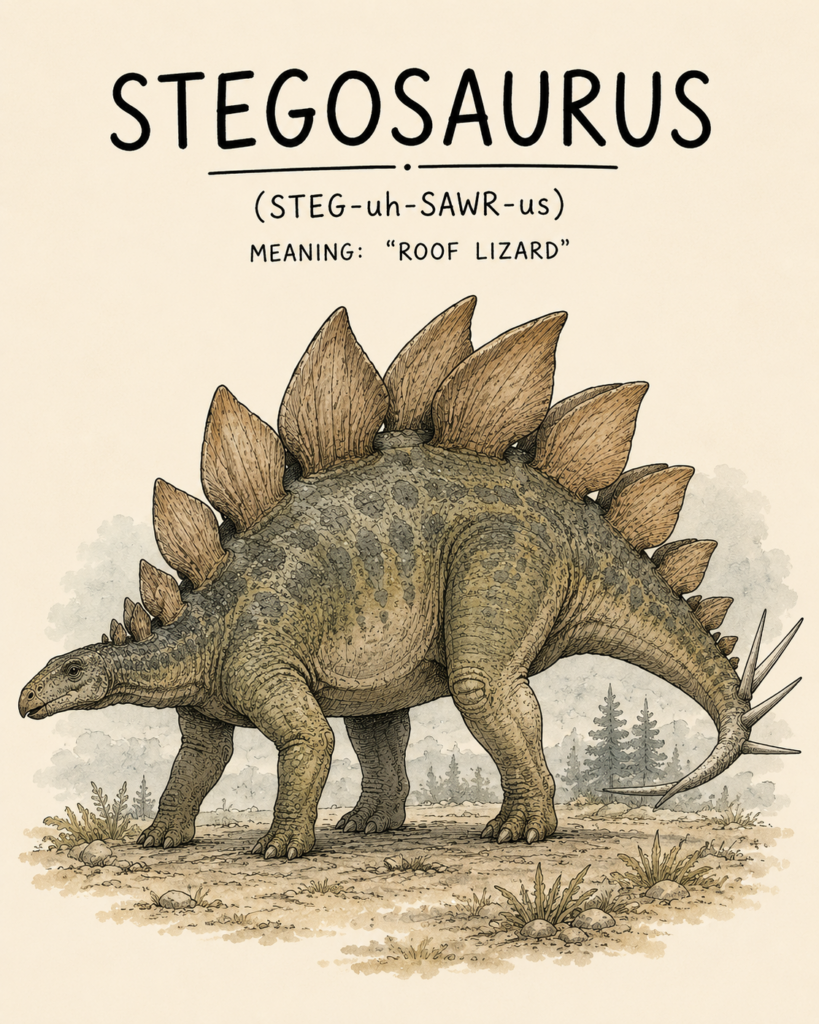
Stegosaurus
Colorado’s official state fossil, Stegosaurus is perhaps the region’s most recognizable dinosaur. With its distinctive plates running along its back and four formidable tail spikes, it was a peaceful plant-eater that browsed among ancient ferns and low-growing vegetation.
Fossils have been discovered throughout western Colorado, including near Dinosaur National Monument and at Dinosaur Ridge near Denver.
Allosaurus
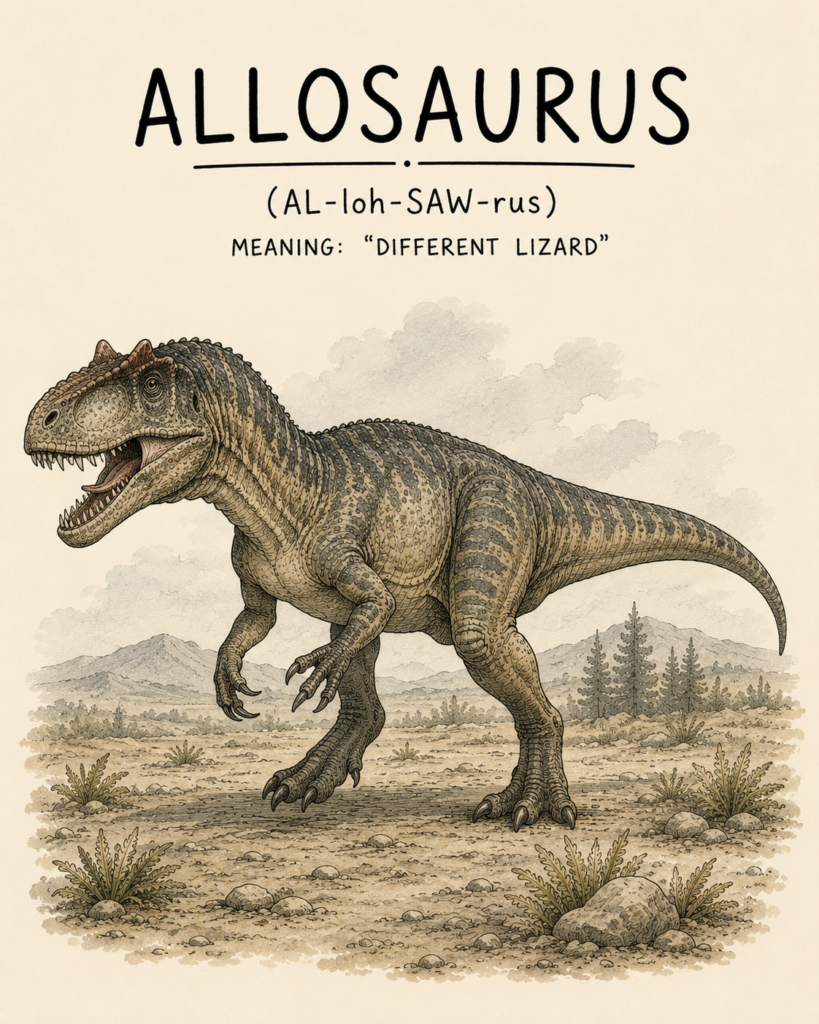
Every ecosystem has a top predator.
During the Late Jurassic, that role belonged to Allosaurus.
Powerful, agile, and armed with sharp teeth and curved claws, it likely hunted large herbivores roaming the floodplains. Some fossil sites in Utah have uncovered dozens of Allosaurus individuals, offering scientists remarkable insights into this iconic predator.
Diplodocus
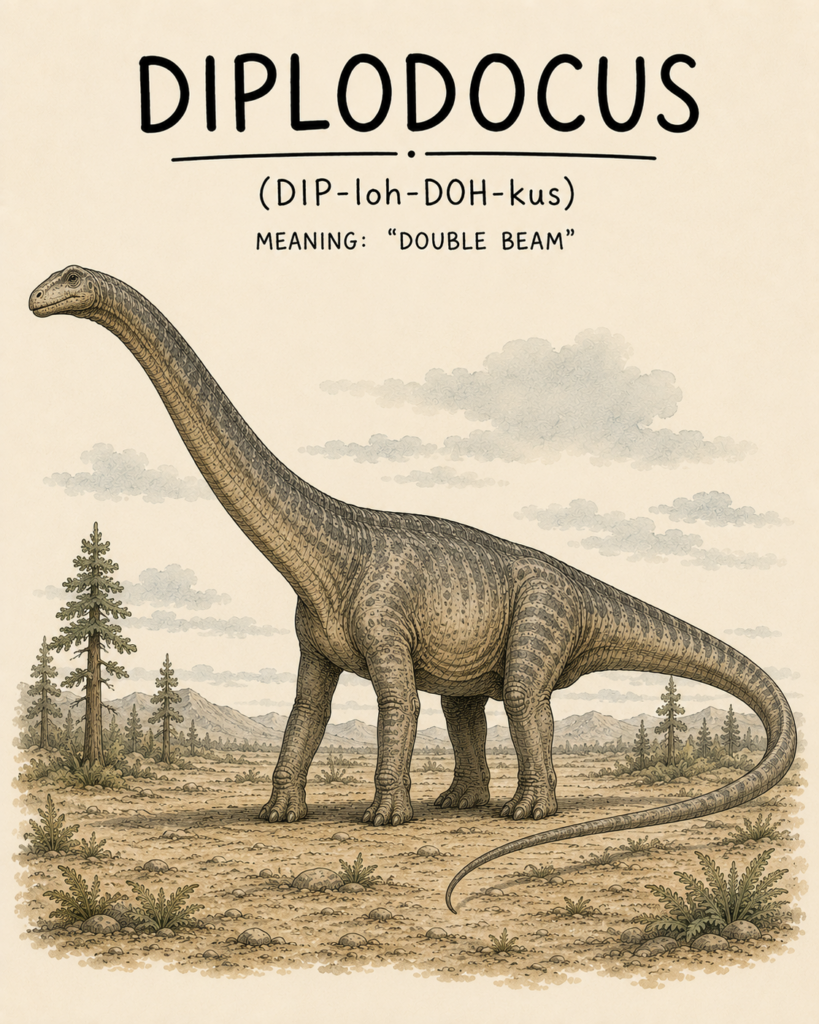
Imagine an animal longer than a basketball court is wide.
With its incredibly long neck and whip-like tail, Diplodocus was one of the largest plant-eaters of its time. Herds likely moved slowly across river valleys in search of fresh vegetation, shaping the landscape much as modern elephants influence African savannas.
Apatosaurus
Once commonly known as Brontosaurus, Apatosaurus was another enormous long-necked herbivore.
Weighing many tons, it wandered ancient floodplains where rivers continually reshaped the land. Fossils discovered at Dinosaur National Monument have helped scientists better understand how these gentle giants lived and moved.
Camarasaurus
While not as famous as some of its Jurassic neighbors, Camarasaurus is actually one of the most common large dinosaurs found in the Morrison Formation.
Its shorter neck and sturdy body suggest it browsed different plants than the longer-necked giants around it, allowing several enormous species to share the same environment.
Fruitadens
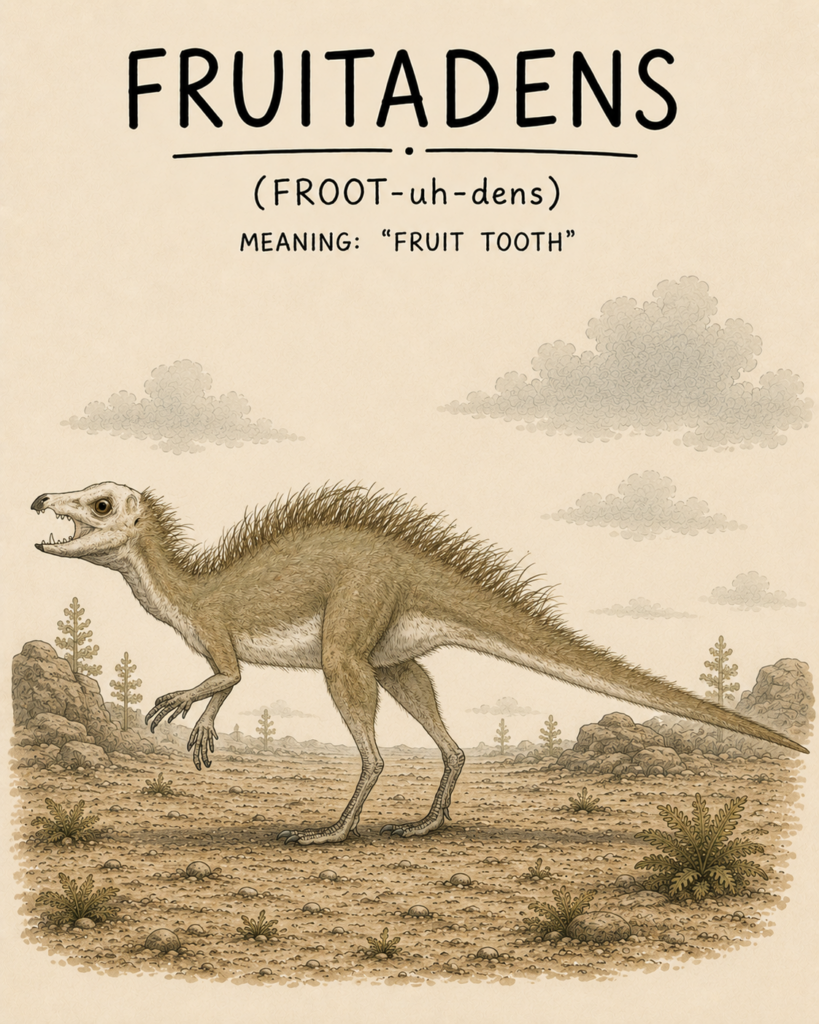
Not every dinosaur was enormous.
Discovered near Fruita, Colorado, Fruitadens was about the size of a house cat and likely darted through the undergrowth searching for plants, insects, and seeds.
Its discovery reminds us that prehistoric ecosystems were just as diverse as modern ones. Alongside giants lived countless smaller animals, each playing an important role in the ancient landscape.
Don’t miss our companion guide:
Trail West Field Guide: Colorado’s Dinosaur Country (coming soon)
Adventure Through Deep Time Begins Right Outside Your Door
One of the biggest misconceptions about dinosaurs is that you have to travel somewhere special to experience them.
A famous museum.
A national monument.
A fossil quarry.
Those places are wonderful—and we hope your family visits many of them.
But becoming an explorer doesn’t begin there.
It begins with learning to notice.
Every neighborhood has rocks.
Every park has patterns.
Every trail tells a story.
The same observation skills used by paleontologists can be practiced almost anywhere, whether you’re hiking in the Rockies, walking to school, or exploring your own backyard.
These simple activities are designed to help children see the world through new eyes.
The goal isn’t to find dinosaurs.
It’s to learn how scientists think.
Build Earth’s Timeline
Recommended Age: 5–10
Time: 20–30 minutes
Materials
- Sidewalk chalk
- Measuring tape
Draw a long timeline on your driveway or sidewalk.
Place major events along it.
Formation of Earth.
First life.
Dinosaurs.
Flowering plants.
Ice Ages.
Humans.
Children quickly discover that dinosaurs lived for an incredibly long time—and that humans appear only in the final moments of Earth’s story.
It’s one of the simplest ways to introduce the idea of deep time.
Learning Objective
Understanding Earth’s history and scale.
Printable: Adventure Through Deep Time Timeline Cards
Design Your Own Dinosaur
Recommended Age: 4–10
Time: 30 minutes
Materials
- Paper
- Colored pencils
Instead of drawing the biggest dinosaur possible, encourage children to think like scientists.
Where does it live?
What does it eat?
How does it stay safe?
What clues in its body tell you those things?
Every feature should have a purpose.
Scientists use this same kind of reasoning when reconstructing extinct animals from fossils.
Learning Objective
Using evidence and imagination together.
Printable: Design a Dinosaur Field Card
Rock Detective Walk
Recommended Age: 4+
Time: 30–45 minutes
Materials
- Backpack
- Magnifying glass
- Notebook
Instead of searching for dinosaurs, search for clues hidden in rocks.
Can you find:
- Three different colors?
- Two different textures?
- Layers?
- Rounded rocks?
- Sharp rocks?
Talk about what each clue might mean.
Was there once a river here?
Did water smooth these stones?
Did the rock break apart from freezing?
Children quickly discover that rocks are storytellers.
Learning Objective
Recognizing geological patterns.
Printable: Rock Detective Checklist
Create a Pretend Dig Site
Recommended Age: 3–7
Time: 30–60 minutes
Materials
- Sandbox or storage bin
- Sand
- Toy dinosaur bones or replica fossils
- Paintbrushes
- Small scoops
Bury “fossils” before your child begins.
Encourage careful excavation rather than digging quickly.
Brush away sand slowly.
Sketch discoveries.
Record where each fossil was found.
Celebrate careful work instead of speed.
That’s exactly how real paleontologists work.
Learning Objective
Patience, observation, and scientific recording.
Printable: Junior Excavation Record Sheet
Backyard Fossil Hunt
Recommended Age: 3–8
Time: 20–30 minutes
Materials
- Small basket or bag
- Magnifying glass (optional)
- Notebook
- Pencil
Invite your child to become a fossil detective.
Walk around your yard or a nearby park looking for anything that seems unusual.
A shell embedded in a rock.
An interesting leaf.
A weathered stick.
A strangely shaped stone.
The important part isn’t whether you’ve actually found a fossil.
It’s learning to slow down and observe carefully before deciding what something might be.
When you return home, compare your discoveries with photographs in books or online field guides.
Learning Objective
Observation, comparison, and scientific curiosity.
Printable: Fossil Discovery Log
Make Your Own Fossils
Recommended Age: 3–8
Time: 20 minutes
Materials
- Air-dry clay or salt dough
- Leaves
- Shells
- Pinecones
- Small toys
Press natural objects into clay to create impressions.
Talk about how real fossils form when plants and animals leave evidence behind in mud that eventually hardens into rock.
Compare your impressions with photographs of actual fossil leaves and footprints.
Learning Objective
Understanding fossil formation through hands-on play.
Printable: How Fossils Form Activity Sheet
Become a Field Scientist
Recommended Age: 4–10
Time: Ongoing
Materials
- Field journal
- Pencil
- Colored pencils
Choose one place your family visits often.
A neighborhood trail.
A nearby creek.
Your backyard.
Visit the same place every few weeks.
Draw what you see.
Notice what has changed.
Has the creek moved?
Are different plants growing?
Have birds returned?
Scientists rarely visit a place only once.
They return again and again because change tells a story.
Learning Objective
Long-term observation and recording evidence.
Printable: My Deep Time Field Journal
Track Detectives
Recommended Age: 4+
Time: 30 minutes
Materials
- Camera
- Notebook
- Measuring tape or ruler
After rain or snow, head outside looking for tracks.
Dogs.
Birds.
Squirrels.
Deer.
Measure them.
Sketch them.
Compare them.
Now ask:
“If these tracks were buried in mud for millions of years, what would scientists learn?”
Suddenly, dinosaur footprints don’t seem quite so mysterious.
Learning Objective
Connecting modern animals with prehistoric evidence.
Printable: Trail West Animal Track Journal
Conclusion: Every Landscape Has a Story
If you’ve made it this far, you probably know something we’ve discovered in our own family.
This guide was never really about dinosaurs.
It was about curiosity.
Dinosaurs simply happen to be one of the best invitations into a much bigger world.
They teach children to imagine landscapes that no longer exist. They encourage questions that don’t have immediate answers. They remind us that the Earth is older, stranger, and more remarkable than we often realize.
But perhaps their greatest gift is something else entirely.
They teach us to pay attention.
The child who stops to examine an unusual rock today may be the same child who notices migrating birds tomorrow, wildflowers next spring, or ancient cliff dwellings on a future family road trip.
The same curiosity that begins with dinosaurs rarely stays there.
It grows.
One question becomes another.
One adventure leads to the next.
That’s exactly what we hope happens for your family.
At Trail West, we believe the outdoors is one of the greatest classrooms a child will ever have… not because every hike teaches a specific lesson, but because every adventure creates space for wonder.
The best family trips aren’t measured by how many attractions you visit or how many miles you hike.
They’re measured by the questions you ask together.
- “Why is this rock red?”
- “Who lived here before us?”
- “How did this canyon form?”
- “What do you think happened here?”
Those questions matter far more than having all the answers.
Because curiosity has a remarkable way of growing alongside the people who nurture it.
One day your child may move on from dinosaurs…. Most do.
The plastic figures will disappear from the bathtub. The dinosaur pajamas will eventually be too small. Another fascination will take their place.
But if you’re lucky, something much more important will remain.
A child who notices.
A child who wonders.
A child who isn’t satisfied with simply walking through the world but wants to understand it.
And perhaps you’ll discover that you’ve changed, too.
You’ll begin seeing mountain ranges as ancient collisions, rivers as patient sculptors, forests as living communities, and every trail as another chapter in an impossibly long story.
Because once you learn to read the landscape, it’s difficult to stop.
That’s the real adventure.