Where Families Can See Real Dinosaurs
One of the greatest things about raising dinosaur-loving kids in—or traveling to—the American West is that you don’t have to imagine where dinosaurs once lived.
You can stand there.
The cliffs, canyons, mesas, and valleys of Colorado, Utah, and Wyoming preserve one of the richest dinosaur records anywhere in the world. In many places, you’re looking at the very same rock layers where Stegosaurus, Allosaurus, Diplodocus, and Apatosaurus once walked.
Some destinations feature towering skeletons inside museums. Others invite families to hike beside fossil beds, walk across ancient riverbanks preserved as stone, or stand inches from dinosaur footprints that haven’t changed in more than 100 million years.
The goal isn’t to visit every dinosaur site.
It’s to help children realize that the landscapes they love today have stories stretching back far beyond human history.
Here are a few of our favorite places to begin.
Choose Your Dinosaur Adventure
- Best first dinosaur museum: Dinosaur Journey
- Best place to see fossils still in the rock: Dinosaur National Monument
- Best dinosaur tracks near a major city: Dinosaur Ridge
- Best hands-on paleontology experience: Wyoming Dinosaur Center
- Best addition to a Moab trip: Mill Canyon
- Best combination of dinosaurs and outdoor recreation: Vernal and Red Fleet
| Destination | Experience | Best ages | Time needed | Indoor/outdoor |
|---|---|---|---|---|
| Dinosaur Journey | Museum and fossil lab | 3+ | 2–3 hours | Indoor |
| Dinosaur Ridge | Tracks and exposed fossils | 4+ | 1–2 hours | Mostly outdoor |
| Dinosaur National Monument | Fossils in place | All ages | Full day | Both |
| Mill Canyon | Dinosaur trackway | 4+ | 30–60 minutes | Outdoor |
| Wyoming Dinosaur Center | Museum and fossil digs | 4+ | 2 hours–full day | Both |
Colorado
Dinosaur Journey Museum
Fruita, Colorado
If Trail West could recommend just one museum to begin your family’s dinosaur adventures, this would be near the top of the list.
Located in the heart of Colorado’s dinosaur country, Dinosaur Journey blends authentic fossils, life-sized reconstructions, interactive exhibits, and hands-on experiences into a museum that appeals equally to curious preschoolers and adults.
What makes this museum especially memorable is its connection to the surrounding landscape. Just outside Fruita lie world-famous fossil quarries where paleontologists continue to make discoveries today.
Why Kids Love It
- Full-size dinosaur skeletons
- Interactive exhibits
- Working paleontology laboratory
- Real fossils from nearby discoveries
Recommended Ages: 3–12+
Suggested Visit: 1.5–3 hours
Nearby Adventures
- Colorado National Monument
- Rabbit Valley trails
- Mygatt-Moore Quarry
- Downtown Fruita
Best Time to Go: Year-round. Summer pairs well with outdoor fossil sites, but the museum is also an excellent hot-weather, cold-weather, or rest-day activity. Hours vary by season.
Indoor, outdoor, or both: Primarily indoor.
Official website: Dinosaur Journey Museum
Trail West Tip: Visit Dinosaur Journey before heading to Rabbit Valley. Recognizing the animals, rock layers, and tools inside the museum will make the outdoor site more meaningful.
Dinosaur Ridge
Morrison, Colorado
Few places allow families to get this close to real dinosaur history.
Rather than viewing fossils behind glass, visitors can walk alongside exposed dinosaur bones and hundreds of fossilized footprints preserved in ancient rock layers.
It’s one thing to see a dinosaur skeleton.
It’s another to place your hand beside a footprint left millions of years ago.
Why Kids Love It
- Real dinosaur tracks
- Outdoor walking experience
- Interactive visitor center
- Easy access from Denver
Recommended Ages: 4+
Suggested Visit: About 1 hour for the visitor center and bus tour; 1.5–2 hours for a self-guided walk.
Nearby Adventures
- Red Rocks Park
- Lookout Mountain
- Denver museums
Indoor, outdoor, or both: Both, but the signature experience is outdoors.
Accessibility and stroller considerations: The self-guided trail is paved and described by Dinosaur Ridge as stroller- and wagon-friendly, but it includes roughly 300 feet of elevation gain and loss. Wheelchair-accessible buses are available; call ahead so staff can confirm availability.
Trail West tip: For younger children—or on a hot day—choose the bus tour. Older kids who like field journals may prefer walking, because it leaves more time to study individual tracks and fossil layers.
Official website: Dinosaur Ridge
Mygatt-Moore Quarry and the Trail Through Time
Rabbit Valley, near Fruita, Colorado
Mygatt-Moore Quarry offers something museums cannot: the chance to visit an active scientific site in the landscape where the fossils were found.
The quarry sits at the beginning of the Bureau of Land Management’s Trail Through Time. Interpretive panels explain the discoveries, excavation methods, and Jurassic environment even when no field crew is present. Visitors can explore the quarry area or continue onto a 1.5-mile loop through high-desert terrain with additional fossils, fossil plants, and signs.
Do not plan a casual visit around seeing paleontologists at work. Excavations, public digs, tours, and demonstrations are seasonal and program-dependent.
Why Kids Love It
- Active fossil excavation
- Real scientific work
- Incredible sense of discovery
Recommended Ages: 5+ for the interpretive quarry; older children may get more from the full trail. Public dig programs set their own minimum ages.
Suggested Visit: 45–90 minutes for the quarry area; 1.5–2.5 hours if completing the loop.
Best time to go: Spring and fall. Summer can be very hot, and the site has little shade beyond the kiosks. The BLM site is open year-round, but weather and road conditions should guide your plans.
Indoor, outdoor, or both: Outdoor.
Accessibility and stroller considerations: Accessible parking and interpretive panels are available at the trailhead. The first portion is relatively level and may work for some mobility devices; the full loop is rocky and uneven. A rugged stroller may manage the opening area better than the complete trail.
Trail West tip: Bring more water than you think you need and download directions before leaving Fruita. Cell service is limited, and there is no drinking water at the site.
Official website: Rabbit Valley Trail Through Time and Mygatt-Moore Quarry
Denver Museum of Nature & Science
Denver, Colorado
For many families, this is where dinosaur fascination begins.
The museum’s world-class fossil halls introduce children to Colorado’s prehistoric past while providing the context that makes later visits to fossil sites even more meaningful.
Why kids love it:
- Towering skeletons,
- immersive environments,
- abundant hands-on learning,
- enough variety to keep the entire family engaged.
Best ages: All ages; especially strong for ages 3–12.
Suggested visit: 3–5 hours for a broad museum visit; 1.5–2 hours if focusing primarily on prehistoric life.
Best time to go: Year-round. Weekday mornings are generally the easiest time for families who prefer a quieter visit.
Indoor, outdoor, or both: Indoor.
Accessibility and stroller considerations: The museum is wheelchair and stroller friendly. A limited number of strollers and non-motorized wheelchairs are available on a first-come, first-served basis.
Reservations or seasonal programs: Advance admission is strongly encouraged. Planetarium shows, theater presentations, and some temporary exhibitions require separate timed tickets.
Trail West tip: Do not try to see everything. Let your child choose one dinosaur, one fossil, and one unanswered question to record before museum fatigue takes over.
Official website: Denver Museum of Nature & Science
Utah
Dinosaur National Monument: Quarry Exhibit Hall
Near Jensen and Vernal, Utah
Dinosaur National Monument spans both Utah and Colorado, but families need to understand one crucial distinction: the Quarry Exhibit Hall and the monument’s publicly viewable dinosaur fossils are on the Utah side, near Jensen. The Colorado side protects spectacular canyons, rivers, scenery, and cultural resources, but it does not offer a public dinosaur-fossil viewing site.
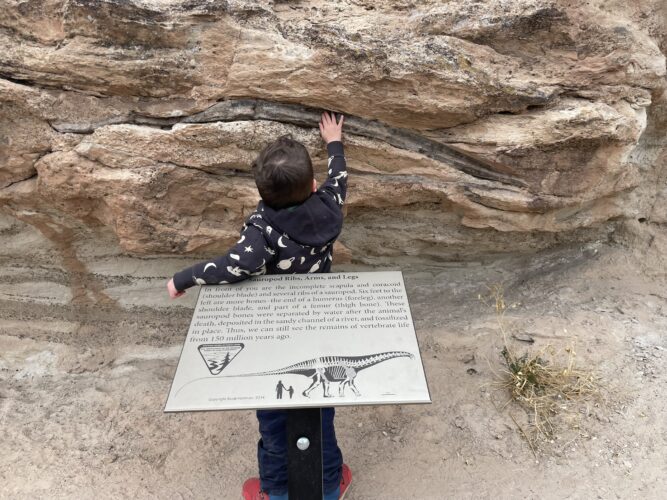
Inside the Quarry Exhibit Hall, more than 1,500 dinosaur bones remain exposed in the cliff face. Instead of removing every fossil and reconstructing the animals somewhere else, the monument protects the original bone-bearing layer. Visitors can even touch real fossils in designated places.
Standing before the quarry wall feels less like looking at a museum display and more like seeing directly into the Jurassic.
Why Kids Love It
- Massive wall of real dinosaur bones
- Scenic drives
- Easy trails
- Junior Ranger program
Recommended Ages: All ages
Suggested Visit: 2–3 hours for the visitor center and Quarry Exhibit Hall; one full day if adding trails, petroglyphs, or a scenic drive.
Nearby Adventures
- Split Mountain
- Green River overlooks
- Vernal
- Red Fleet State Park
Best time to go: Spring through fall for the fullest mix of fossil viewing and outdoor exploration. The Quarry Exhibit Hall can also be a rewarding winter stop when roads and facilities are open.
Indoor, outdoor, or both: Both. The quarry wall is protected inside a building; most other monument experiences are outdoors.
Accessibility and stroller considerations: The Quarry Exhibit Hall has an accessible ramp connecting its levels, but no elevator. During the summer shuttle season, visitors who cannot hike or board the shuttle may drive a personal vehicle to the hall. A wheelchair is available to borrow upon request.
Trail West tip: Use the Quarry Exhibit Hall as the nonnegotiable centerpiece of your visit, then add only one outdoor activity. The monument is enormous, and trying to cover both the Utah and Colorado sides in a single day turns an extraordinary place into a long drive.
Official website: Dinosaur National Monument and Quarry Exhibit Hall information
Utah Field House of Natural History State Park Museum
Vernal, Utah
The Utah Field House is the natural companion to Dinosaur National Monument. It gives families the scientific and environmental context that the quarry wall alone cannot provide.
Exhibits explore dinosaurs, fossils, geology, and the ancient environments of the Uinta Basin, while the outdoor Dinosaur Garden lets children move among life-size prehistoric reconstructions. Because the museum also houses a visitor-information center, it is a useful first stop for checking current conditions and refining a Vernal-area itinerary.
Why kids love it:
- Large dinosaur reconstructions
- real fossils
- a walk-through outdoor Dinosaur Garden
- a museum experience that feels manageable rather than overwhelming.
Best ages: 3–12+.
Suggested visit: 1.5–2.5 hours.
Best time to go: Year-round. Spring through fall is best if you want to combine the indoor exhibits with the outdoor garden and nearby fossil sites.
Indoor, outdoor, or both: Both.
Accessibility and stroller considerations: The main museum is a conventional indoor visitor facility and is the easiest Vernal dinosaur stop for strollers and many mobility needs. Contact the park directly for current details about routes through the outdoor garden.
Trail West tip: Visit the Field House before the national monument if your kiddo is new to fossils. The exhibits establish the story; the quarry wall delivers the unforgettable reveal.
Official website: Utah Field House of Natural History State Park Museum
Mill Canyon Dinosaur Tracksite
Near Moab, Utah
Mill Canyon is not simply a place with a few isolated footprints. The Early Cretaceous surface contains more than 200 tracks and traces representing at least ten kinds of animals, including carnivorous dinosaurs, long-necked sauropods, ornithopods, ankylosaurs, birds, and crocodiles.
The tracks preserve movement rather than bones. Children can begin asking the questions paleontologists ask: Which direction was the animal traveling? Was it walking alone? How large was it? What kind of surface held the print?
The site’s access infrastructure has undergone changes, so families should review the BLM page for current conditions immediately before visiting.
Why Kids Love It
- Walking where dinosaurs actually walked.
- It doesn’t get much better than that.
Best ages: 4+; younger children can enjoy it with close supervision.
Suggested visit: 45–75 minutes for the tracksite. Allow longer if adding the separate Bone Trail.
Best time to go: Spring and fall, or early morning in summer. Avoid the heat of the day and do not visit during muddy road conditions.
Indoor, outdoor, or both: Outdoor.
Accessibility and stroller considerations: The BLM describes the tracksite boardwalk as wheelchair accessible. The separate Bone Trail crosses slickrock, uneven ground, and unpaved boardwalk sections and is generally not wheelchair accessible. Use a rugged stroller only after checking current surface and boardwalk conditions.
Trail West tip: The tracks are fragile. Keep children on the marked route and boardwalk, and never step onto the track-bearing surface—even when a closer look is tempting.
Perfect Pairing
- Moab family adventures – Moab Family Adventure Itinerary (3-day)
- Arches National Park
- Dead Horse Point
Official website and conditions: BLM Mill Canyon Dinosaur Trailhead Interpretive Site
Red Fleet State Park Dinosaur Trackway
Vernal, Utah
Red Fleet offers one of the region’s most adventurous family track experiences—but it should not be described as a short, easy walk.
Reaching the main tracksite requires a roughly three-mile round-trip hike over varied terrain with repeated uphill and downhill sections. Utah State Parks describes the route as strenuous. The reward is a sandstone track surface marked by three-toed dinosaur footprints overlooking Red Fleet Reservoir.
Tracks can be difficult to recognize when the sun is directly overhead. Angled light in the early morning or late afternoon makes the impressions easier to see.
Why kids love it:
- A genuine hiking objective,
- the satisfaction of finding tracks in the landscape,
- the combination of dinosaurs, sandstone, and water.
Best ages: 6+ for most families, depending on hiking experience, heat tolerance, and willingness to manage sustained ups and downs.
Suggested visit: 2–3 hours for the hike; longer if adding a picnic, swim, paddle, or campground stay.
Best time to go: Spring or fall. In warmer months, start early or visit late for cooler temperatures and better track visibility.
Indoor, outdoor, or both: Outdoor.
Accessibility and stroller considerations: The trackway trail is not stroller or wheelchair accessible. Expect uneven rock, elevation changes, and exposed conditions.
Trail West tip: Treat the tracks as the reward at the end of a real hike. Carry ample water, use sun protection, download the trail information, and turn around if heat or fatigue begins to overtake the fun.
Official website: Red Fleet State Park and current conditions
Natural History Museum of Utah
Salt Lake City
Few museums explain the relationship between geology, landscapes, evolution, and dinosaurs as clearly as the Natural History Museum of Utah.
Rather than presenting dinosaur skeletons as isolated monsters, the museum places them within Utah’s changing environments and extraordinary fossil record. It is an excellent beginning or ending point for a larger Utah dinosaur trip because it helps children connect individual discoveries to the story of the land.
Why kids love it: Dramatic skeletons, hands-on science, expansive views, and exhibits that move naturally from rocks and landscapes to ancient life.
Best ages: All ages; especially strong for ages 4–12+.
Suggested visit: 2.5–4 hours.
Best time to go: Year-round. It is especially useful on a very hot, snowy, or smoky day when outdoor plans are less appealing.
Indoor, outdoor, or both: Primarily indoor.
Accessibility and stroller considerations: Museum entrances are accessible to wheelchairs and strollers. Wheelchairs are available to borrow, but stroller rentals are not currently offered.
Trail West tip: Begin at the top of the museum and work downward. Give children one simple mission—find evidence that Utah’s environment has changed—so the visit becomes an investigation instead of a race past skeletons.
Official website: Natural History Museum of Utah
St. George Dinosaur Discovery Site at Johnson Farm
St. George, Utah
The St. George Dinosaur Discovery Site is compelling because the museum was built around the fossil-bearing surface itself.
Visitors see dinosaur tracks and other traces within an approximately 200-million-year-old Early Jurassic lake ecosystem, preserved where they were found. The site includes footprints, swim traces, plant remains, fish fossils, and sedimentary features that help families imagine an entire living environment—not only the dinosaurs passing through it.
Why kids love it:
- Real dinosaur pathways under the museum,
- clear track shapes, an outdoor dinosaur park,
- a sandbox,
- the feeling that the building is protecting an active discovery site.
Best ages: 3–12+, with enough scientific depth for adults and older children.
Suggested visit: 1.5–2.5 hours.
Best time to go: Year-round. The indoor setting makes this an especially good midday or hot-weather stop in southern Utah.
Indoor, outdoor, or both: Both, with the most important fossils protected indoors.
Accessibility and stroller considerations: The museum has ADA-compliant walkways and ramps, no interior stairs, and a walker with a built-in seat available upon request. Strollers should work well on the main visitor routes.
Trail West tip: Ask children to identify the difference between a body fossil and a trace fossil. This site is one of the best places to show that footprints, drag marks, and sediment patterns can reveal behavior without preserving a skeleton.
Official website: St. George Dinosaur Discovery Site
Wyoming
Wyoming Dinosaur Center
Thermopolis, Wyoming
The Wyoming Dinosaur Center is one of the best places in the West for families who want to move beyond looking at fossils and experience how paleontology happens.
The museum displays an extensive fossil collection, while seasonal tours and field programs connect visitors with nearby dig sites. Options range from museum admission and shorter site experiences to half-day or full-day programs. The center’s public dig opportunities are real field experiences, not guaranteed casual add-ons to a museum ticket.
Why kids love it:
- Large mounted skeletons,
- a visible connection between museum displays and local dig sites,
- the possibility of doing real field or preparation work.
Best ages: 4+ for the museum. Current field programs set their own age minimums; several allow participants age 3 and older with an accompanying parent or guardian, while the two-day Kids’ Dig is designed for ages 6–13.
Suggested visit: 2–3 hours for the museum; a half day or full day for a field program.
Best time to go: Summer for the widest selection of dig-site tours and field programs. The museum remains a worthwhile year-round destination.
Indoor, outdoor, or both: Both. Museum galleries are indoors; dig-site tours and excavation programs are outdoors.
Accessibility and stroller considerations: The museum is the most practical portion for strollers and mobility devices. Field sites involve dry, exposed, uneven terrain, and some programs warn of strenuous hills. Contact the center before booking if anyone in your group has mobility, heat, or endurance concerns.
Reservations or seasonal programs: Museum admission can be purchased separately. Dig for a Day, Shovel Ready, Kids’ Dig, and other field programs are seasonal, capacity-limited, and require advance reservations.
Trail West tip: Match the program to your child’s patience, not just their dinosaur enthusiasm. A two-hour museum visit may delight a preschooler; a serious field day is best for a child who can work slowly outdoors and follow instructions.
Official website: Wyoming Dinosaur Center
Make a Weekend of It: Thermopolis
Thermopolis is more than the address of the Wyoming Dinosaur Center—it is a comfortable family base for a two-night dinosaur trip.
At Hot Springs State Park, families can walk beside mineral terraces, cross the Bighorn River, soak in the State Bath House, and view the park’s bison herd from the safety of their vehicle. The park includes a mix of universally accessible and conventional hiking trails. Because facilities and concession operations can change, check the official park page before promising children a specific pool or attraction.
Pair one focused dinosaur day with a slower day of soaking, picnicking, wildlife watching, and river walking. That balance often works better with young children than scheduling paleontology from morning to night.
Official website: Hot Springs State Park
Tate Geological Museum
Casper, Wyoming
The Tate Geological Museum at Casper College is a smaller, research-connected museum that makes an excellent stop for families crossing central Wyoming.
Its collections span dinosaurs, marine reptiles, mammals, minerals, and Wyoming geology. Museum staff conduct fieldwork and fossil preparation, and the exhibits include both major specimens and the kinds of smaller discoveries that help children understand paleontology as a working science.
Why kids love it:
- Dinosaurs, fossils, rocks,
- a visible scientific setting,
- an approachable size that does not require an entire day.
Best ages: 4+; especially good for school-age children who enjoy asking detailed questions.
Suggested visit: 1–2 hours.
Best time to go: Year-round during museum hours. It is closed on Sundays, so plan road-trip timing carefully.
Indoor, outdoor, or both: Primarily indoor.
Accessibility and stroller considerations: As a campus museum, the main galleries are generally practical for strollers and mobility devices, but families with specific access needs should contact the museum before arrival.
Trail West tip: This is a strong road-trip reset: small enough to avoid museum overload, but rich enough to give a curious child one new fossil or geologic mystery to carry into the next stop.
Official website: Tate Geological Museum
Paleontology-History Sidebar: Como Bluff and the Bone Wars
Few places played a larger role in the early history of American paleontology than Como Bluff, east of Medicine Bow, Wyoming.
Beginning in the late 1870s, fossils found in the Morrison Formation here fueled the intense scientific rivalry known as the Bone Wars. Discoveries from the area helped introduce the world to dinosaurs including Apatosaurus, Allosaurus, Camarasaurus, Diplodocus, and Stegosaurus, and specimens collected here became foundational pieces of major museum collections.
Como Bluff is historically fascinating, but it is not equivalent to the visitor-ready destinations in this guide. The fossil beds and historic dig site are not open for casual public exploration. Families can view the ridge from U.S. Highway 30 and use the landscape to discuss the history of discovery, competition, and scientific ethics, but should not enter private land or approach closed quarry areas.
For a more actionable Wyoming dinosaur experience, visit the Wyoming Dinosaur Center, Tate Geological Museum, or University of Wyoming Geological Museum.
Learn more: Wyoming State Geological Survey guide to Como Bluff
Fossil-site etiquette:
Leave vertebrate fossils and tracks in place, avoid tracing, casting, wetting, or touching fragile impressions, and report possible discoveries to the appropriate land manager.
Explorer Map
Colorado’s Dinosaur Country (coming soon)
- Dinosaur National Monument
- Fruita & Dinosaur Journey Museum
- Mygatt-Moore Quarry
- Dinosaur Ridge
- Rabbit Valley
- Western Colorado Morrison Formation
- Major Jurassic fossil localities
Continue the Adventure
Ready to explore Colorado’s prehistoric past in person?
Don’t miss our companion guide:
Trail West Field Guide: Colorado’s Dinosaur Country (coming soon)
Inside you’ll find family-friendly museums, fossil sites, scenic drives, hikes, and road trip itineraries that bring the Morrison Formation—and the age of dinosaurs—to life.