You can plan a trip around ancient temples, quiet villages, and centuries of history…
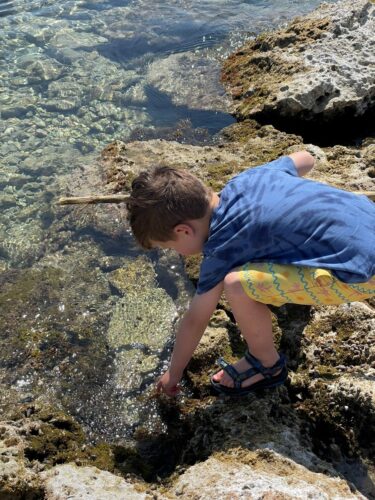
and still spend most of your time watching your kid poke at tide pools and chase melting gelato down their arm.
Both can be true.
And once you realize that, something important shifts—not just in how you travel, but in how you measure whether a trip was “successful” at all.
The Trip You Plan
Most trips begin with a vision.
It’s shaped by photos you’ve saved, articles you’ve read, conversations you’ve had for years. You imagine:
- Wandering through stone streets that feel unchanged by time
- Standing in places that hold weight and meaning
- Taking in views that make you pause, even just for a moment
It’s a version of travel that feels intentional.
The kind of experience where you should slow down. Where you should appreciate what you’re seeing.
And when you arrive… you do.
You visit the places. You take it in. You check the boxes, even if gently.
That version of the trip exists. It matters. It’s part of why you came.
The Trip That Emerges
But alongside that… another version starts to unfold.
It’s smaller. Quieter. Closer to the ground.
It doesn’t announce itself the same way. It doesn’t make the itinerary.
It looks like:
- Sticky hands from too much ice cream
- Tiny rocks or shells that become temporary treasures
- An endless fascination with water—fountains, puddles, tide pools, anything
- Stopping… constantly… for things you would have walked right past
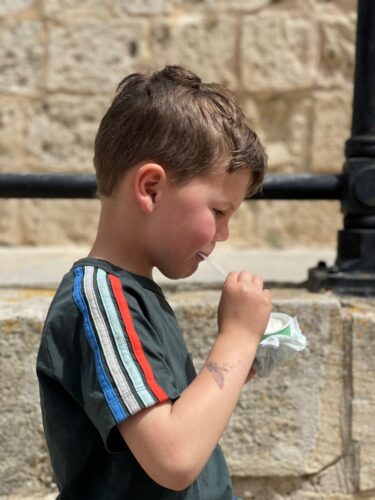
It doesn’t feel “important” in the same way.
But it holds attention. Fully.
And if you’re honest… that’s where the magic lives for them.
The Illusion of the Tradeoff
It’s easy, especially early on, to interpret this as a tradeoff.
You came for one thing.
They’re interested in another.
The narrative writes itself:
We’re not really experiencing this place the way we intended.
We’re missing something.
We’ll come back someday and do it “right.”
But that framing misses what’s actually happening.
Because it’s not one trip replacing another.
It’s two trips happening at the same time.
Parallel Experiences, Shared Space
On the surface, you might be standing in the same place.
But you’re experiencing it differently.
Your lens:
- Context
- History
- Scale
- Meaning
Their lens:
- Texture
- Movement
- Curiosity
- Play
And instead of competing… these perspectives layer.
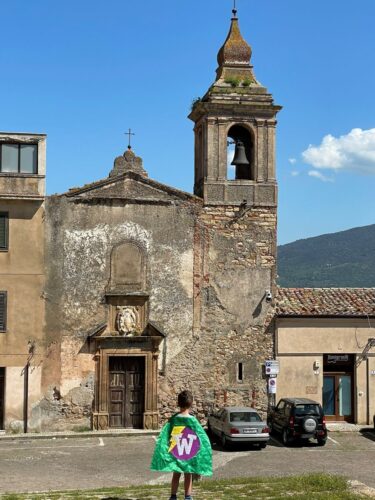
The historic site becomes more memorable
because you remember the snack break in the shade,
the game played on the steps,
the question—“who built this?”—that you didn’t expect.
The scenic village isn’t just beautiful—
it’s where you found the tiny shop with the best ice cream,
sat longer than planned,
and realized no one was in a hurry to leave.
Nothing is diminished.
It’s expanded.
Redefining What “Counts”
This is where many trips quietly transform.
Because when you let go of the idea that only certain moments “count,” you start to see the full picture.
The in-between moments stop feeling like interruptions.
They become the experience.
A delay becomes an opportunity.
A detour becomes the story.
A pause becomes the memory that sticks.
And often, those are the moments that are remembered most clearly—long after the details of the “main attraction” fade.
The Real Skill: Holding Both
Traveling with kids doesn’t mean abandoning your interests.
It means learning to hold two sets of expectations at once.
You can:
- Seek out the places that matter to you
- While leaving space for the moments that matter to them
You can:
- Plan thoughtfully
- Without over-structuring every hour
You can:
- Move with intention
- And still allow for spontaneity
This isn’t about lowering expectations.
It’s about widening them.
A Different Kind of Pace
To make this work, the biggest adjustment isn’t where you go.
It’s how you move.
You walk slower.
You stop more often.
You leave gaps in the day.
You accept that you might not see everything.
And in exchange—you actually experience more.
More connection.
More presence.
More of the place as it is, not just as it was imagined.
The Goal Was Never the Itinerary
It’s easy to think the goal of a trip is to execute the plan well.
To see the right things.
At the right time.
In the right way.
But over time, that goal tends to soften.
Because the moments that stay with you aren’t always the ones you planned.
They’re the ones that happened when you weren’t paying attention to the plan at all.
What You Almost Walked Past
The truth is:
You can build a beautiful itinerary.
You can research every stop.
You can map out a perfect route.
And you still won’t be able to predict the highlight.
Because sometimes, the best part of the day is the thing you almost walked past.
The side street.
The tide pool.
The second scoop of ice cream.
The moment that wasn’t supposed to matter—but did.
A Final Thought
You don’t have to choose between your trip and their trip.
You can hold both.
You can experience a place through your own lens—
and through theirs.
And somewhere in the overlap, something better emerges.
Not the trip you planned.
But the one you’ll actually remember.